IBC Tank Recycling Programs
Every IBC tote that enters our facility gets a second chance. Our comprehensive recycling programs recover up to 95% of materials from end-of-life containers, transforming waste into valuable resources while keeping hundreds of tons of plastic and steel out of landfills each year.
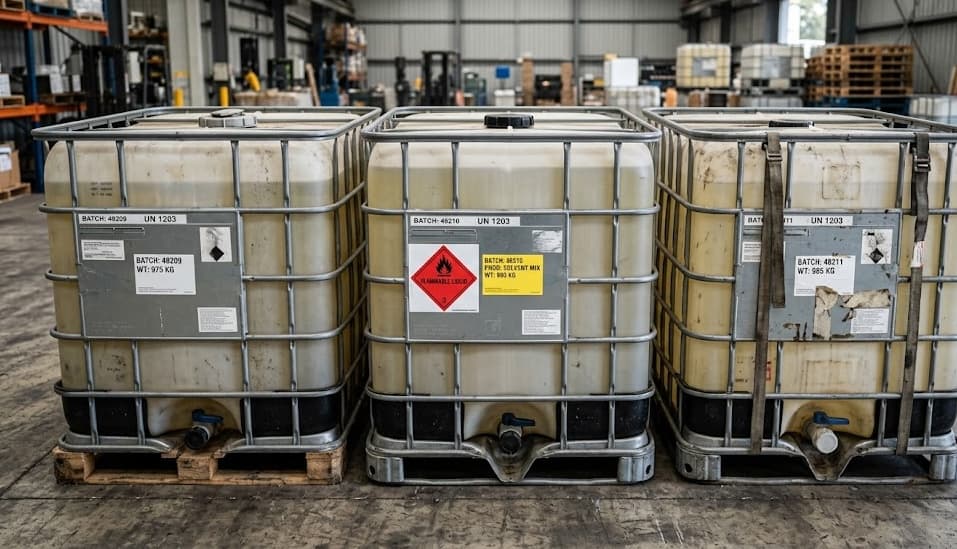
Containers arrive labeled and tracked through our entire recycling process
The Numbers That Matter
Recycling isn't just good business — it's a responsibility. Here's how our programs are making a measurable difference for the planet.
12,000+
Tanks recycled annually
95%
Material recovery rate
780 tons
Plastic diverted from landfills
340 tons
Steel recovered and reprocessed
From End-of-Life to New Beginning
Our state-of-the-art recycling facility in Louisville, KY follows a rigorous multi-step process to maximize material recovery and minimize environmental impact.
Collection & Intake
IBC tanks are collected from businesses, warehouses, and distribution centers across the country. Each container is logged, photographed, and assigned a tracking number for full chain-of-custody documentation.
Full traceability from pickup to processed materials
Assessment & Sorting
Every tank undergoes a thorough inspection. Containers that can be reconditioned and reused are separated from those destined for material recycling. We prioritize reuse over recycling whenever possible, as it requires less energy and produces fewer emissions.
Reuse-first philosophy reduces overall environmental impact by 60%
Disassembly
Tanks slated for recycling are carefully disassembled into their three primary components: the HDPE (high-density polyethylene) inner bottle, the galvanized steel cage frame, and the wooden or composite pallet base. Each material stream is processed separately.
Three distinct material streams for maximum recovery
Cleaning & Decontamination
All components are thoroughly cleaned and decontaminated before processing. Residual chemicals are captured, neutralized, and disposed of in accordance with EPA regulations. Rinse water is treated and recycled through our closed-loop water system.
Zero discharge — all water is recycled on-site
Material Processing
HDPE bottles are shredded, washed, and pelletized into raw resin that manufacturers use to produce new containers, pipes, and industrial products. Steel cages are cut, baled, and sent to foundries for melting and reforging. Wood pallets are repaired for reuse or chipped for biomass fuel.
Recycled HDPE uses 88% less energy than virgin plastic production
Quality Verification & Reporting
Processed materials undergo quality testing to ensure they meet industry standards for recycled content. We provide detailed recycling certificates, weight reports, and diversion documentation to every client for their sustainability records.
Comprehensive documentation for ESG and compliance reporting
Every Material Gets a New Life
HDPE Plastic
Second-life uses: New containers, pipes, playground equipment, lumber alternatives, automotive parts
Recycling one ton of HDPE saves 5,774 kWh of energy, 16.3 barrels of oil, and 30 cubic yards of landfill space.
Galvanized Steel
Second-life uses: New steel products, construction materials, automotive components, appliances
Recycling steel uses 74% less energy than producing new steel from ore and reduces CO2 emissions by 58%.
Wood Pallets
Second-life uses: Repaired pallets for reuse, wood chips for landscaping, biomass fuel for energy generation
Reusing pallets saves trees, reduces deforestation, and keeps wood waste out of methane-producing landfills.
Corporate Recycling Programs
We design custom recycling programs for businesses of all sizes. Whether you generate 10 end-of-life IBC totes per month or 1,000, we'll create a turnkey program that fits your operations and your sustainability goals.
Compliance & Regulations
IBC tank disposal is subject to federal and state environmental regulations. Improper disposal can result in significant fines and environmental liability. Our programs ensure full compliance with:
EPA RCRA Guidelines
Proper handling and documentation of containers that held hazardous materials.
DOT Regulations
Compliant transport of used containers, including those with residual contents.
State Environmental Laws
Adherence to state-specific recycling mandates and waste diversion requirements.
OSHA Standards
Safe handling procedures for all container types, including those with chemical residues.
Why IBC Recycling Matters
An estimated 1.5 million IBC totes reach end-of-life in the United States every year. Without proper recycling, that's over 195 million pounds of plastic and 97 million pounds of steel headed for landfills — or worse, illegal dumping sites.
By choosing IBC Recycle Services, you're actively reducing demand for virgin plastic production, lowering greenhouse gas emissions, conserving fossil fuels, and supporting a circular economy that keeps valuable materials in productive use for decades longer.
Together, we can close the loop on industrial container waste. One IBC tote at a time.
Recycling Solutions by Industry
Different industries generate end-of-life IBC totes with unique characteristics and challenges. Our recycling programs are tailored to meet the specific requirements of each sector.
Chemical Manufacturing
Chemical plants generate thousands of end-of-life IBC totes annually, many containing hazardous residues that require specialized handling. Our RCRA-compliant recycling process safely handles containers that held acids, bases, solvents, and specialty chemicals.
Food & Beverage Processing
Food processors generate large volumes of IBC totes from incoming ingredient shipments. These containers often have stubborn organic residues (syrups, oils, concentrates) that require thorough cleaning before materials can be recycled or the tote reconditioned.
Pharmaceutical & Biotech
Pharmaceutical operations require the highest levels of documentation and regulatory compliance in their waste management. Our recycling programs for pharma clients include batch-level traceability, validated destruction processes, and certificates of recycling for every container.
Agriculture & Agrochemical
Agricultural operations accumulate IBC totes from fertilizer, herbicide, pesticide, and adjuvant purchases throughout the growing season. Our seasonal pickup programs collect these containers efficiently during off-peak months when farm schedules allow.
Automotive & Industrial Manufacturing
Manufacturing facilities use IBC totes for coolants, lubricants, adhesives, paints, and coating materials. End-of-life containers from these applications often have complex, multi-layer residues that require our advanced chemical cleaning before recycling.
Water Treatment & Utilities
Municipal and private water treatment operations consume IBC totes of sodium hypochlorite, polymer flocculants, pH adjusters, and other treatment chemicals. These containers are ideal candidates for recycling due to their consistent material composition and predictable generation rates.
Recycling Program Cost Factors
IBC recycling costs vary based on several factors. In many cases, businesses actually receive payment for their recyclable containers rather than paying for disposal. Here is what determines the economics.
Container Condition & Reuse Potential
Containers that can be reconditioned for resale have the highest value and can generate revenue for the seller. End-of-life containers that can only be processed for materials still carry value based on the current HDPE resin and scrap steel markets. Only severely contaminated containers may incur processing fees.
Revenue: $5-$70/tote for sellable containers | Material value: $3-$15/tote for recycling-only
Previous Contents & Contamination Level
Containers that held non-hazardous materials (food, water, soaps) are the simplest and most cost-effective to recycle. Containers with hazardous residues require additional decontamination steps that may affect pricing. Containers with unknown contents require testing before processing, adding a small per-unit fee.
Non-hazardous: Standard pricing | Hazardous: $10-$30/tote additional processing
Volume & Program Frequency
One-time pickups of small quantities are priced differently than ongoing monthly programs. Businesses that commit to recurring pickups receive the best per-unit economics because we can optimize routing and schedule efficiency. Programs of 50+ totes per month typically qualify for revenue-sharing arrangements.
One-time: Standard rates | Monthly programs (50+): Revenue sharing available
Pickup Location & Distance
Pickup is free within 200 miles of Louisville, KY for qualifying quantities. Beyond that range, a flat-rate transportation fee applies based on distance. For businesses on our established weekly routes, pickup is included at no additional charge regardless of distance.
Within 200 miles: Free | 200-500 miles: $1.50-$3/mile | On route: Free
Documentation & Reporting Requirements
Standard recycling certificates and weight reports are included with every program at no extra charge. Enhanced documentation packages for ESG reporting, ISO 14001 audits, or regulatory compliance may carry a nominal fee for the additional administrative work involved.
Standard documentation: Included | Enhanced ESG/compliance packages: $50-$200/quarter
Minimum Quantities
We accept recycling pickups starting at just 4 IBC totes for locations within our free pickup zone. For locations outside the zone, minimum quantities start at 10-20 totes to justify transportation costs, though we can consolidate smaller quantities with nearby pickups when available.
Local minimum: 4 totes | Extended area: 10-20 totes | On-route: No minimum
What Businesses Say About Our Recycling Programs
“Before partnering with IBC Recycle Services, we were stockpiling 200+ empty totes per year in our back lot because we did not know how to dispose of them properly. Now they pick up monthly, we get paid for the usable ones, and we have documentation for our sustainability report. It solved a problem we had been ignoring for years.”
William Torres
Environmental Health & Safety Director
Apex Chemical Manufacturing, Indianapolis, IN
“The recycling certificates they provide are exactly what our auditors needed for ISO 14001 compliance. Every container is tracked from pickup to final processing. The level of documentation is far beyond what any other recycler we evaluated could offer. This program practically runs itself.”
Karen Mitchell
Quality & Compliance Manager
Precision Coatings Inc., Columbus, OH
“As a municipality, we generate dozens of IBC totes from water treatment chemicals every month. IBC Recycle Services set up a program that integrates with our existing waste management contract. Their monthly pickups and reporting fit seamlessly into our operations. The best part is that it costs us nothing because the container value covers the service.”
David Armitage
Public Works Superintendent
City of Bowling Green, KY
“We switched from a general waste hauler to IBC Recycle Services specifically for their material recovery capabilities. Our previous vendor was landfilling everything. Now 95% of our container materials are recovered and recycled. That fact alone justified the switch for our corporate sustainability team.”
Michelle Park
Sustainability Director
Heartland Foods Group, St. Louis, MO
“We run a large agricultural distribution center and generate 400+ empty IBC totes per season from fertilizer and adjuvant deliveries. The seasonal pickup program IBC Recycle Services designed for us collects everything in two visits after harvest. Clean, efficient, and we get a check instead of a disposal bill.”
Tom Bradshaw
Operations Manager
Central Valley Ag Supply, Terre Haute, IN
“The environmental impact reports they provide are a game-changer for our ESG disclosures. We can now quantify exactly how many tons of plastic and steel we diverted from landfills, how much energy was saved, and what our carbon offset equivalent is. Our investors and customers love seeing those numbers.”
Rachel Nguyen
VP of Corporate Responsibility
Allied Industrial Solutions, Nashville, TN
Quantifying the Environmental Benefits
Recycling IBC totes produces measurable, verifiable environmental benefits that extend far beyond simply keeping waste out of landfills.
Energy Conservation
Recycling HDPE plastic uses 88% less energy than producing virgin HDPE from petroleum. For every ton of HDPE we recycle from IBC bottles, we save the equivalent of 5,774 kWh of electricity — enough to power an average American home for six months.
Steel recycling is similarly efficient. Reprocessing the galvanized steel from IBC cage frames uses 74% less energy than smelting new steel from iron ore. Each ton of recycled steel saves approximately 2,500 kWh of energy and 1.8 tons of iron ore that does not need to be mined.
Combined, our annual recycling operations conserve approximately 4.2 million kWh of energyper year — equivalent to removing the energy consumption of 390 homes from the grid.
Greenhouse Gas Reduction
Virgin plastic production is a significant source of greenhouse gas emissions, releasing approximately 1.89 tons of CO2 per ton of HDPE produced. By recycling instead of manufacturing new, we avoid the vast majority of these emissions.
Steel production from iron ore generates approximately 1.85 tons of CO2 per ton of steel. Recycling reduces this by 58%, to approximately 0.78 tons per ton. The difference is a net CO2 reduction of 1.07 tons for every ton of cage steel we recycle.
Our total verified greenhouse gas avoidance for the past year was 1,850 metric tons of CO2 equivalent— comparable to the annual emissions of 400 passenger vehicles. Every business that participates in our recycling program contributes to this collective impact.
Water & Resource Conservation
Our closed-loop water treatment system recycles 97% of the water used in our cleaning and decontamination processes. This means approximately 2.3 million gallons of water are conserved annually compared to a single-pass water system.
Beyond water, recycling HDPE reduces the demand for petroleum feedstocks. Every ton of recycled HDPE eliminates the need for approximately 16.3 barrels of crude oil that would have been consumed in virgin plastic production. At our current recycling volume, that represents over 6,300 barrels of oil conserved per year.
Landfill Diversion
A single IBC tote occupies approximately 48 cubic feet of landfill space when disposed of intact. Shredded, the materials still consume significant volume. By recycling 12,000+ totes per year, we divert over 1,100 tons of material from landfills and eliminate the need for approximately 576,000 cubic feet of landfill capacity.
Landfill diversion also eliminates the long-term environmental risks associated with plastic degradation in landfills, including microplastic generation, groundwater contamination from leachate, and methane emissions from organic residues decomposing in anaerobic conditions.
Where We Collect Containers
Our recycling pickup network covers the entire continental United States. Here is how our service area and logistics work for recycling program clients.
Core Zone (Free Pickup)
0-200 miles from Louisville
KY, southern IN, southwestern OH, northern TN, eastern IL
Free pickup for 4+ totes. Same-week service. No minimum for on-route locations. Our trucks run daily routes throughout this zone.
Primary Zone
200-500 miles
OH, MI, GA, AL, NC, SC, VA, WV, IL, MO
Weekly scheduled routes. Free pickup for 20+ totes. Flat-rate transport fee for smaller quantities. 2-3 day pickup response.
Extended Zone
500-1,000 miles
PA, NY, NJ, MA, MN, IA, WI, AR, MS, LA, FL
Biweekly routes through carrier partners. Free pickup for 40+ totes or full truckloads. 5-7 day pickup scheduling.
National Zone
1,000+ miles
TX, CO, AZ, CA, NV, OR, WA, and all remaining states
Full truckload pickups (48+ totes). Competitive national freight rates. We consolidate with partner recyclers when local processing is more efficient.
How Recycling Pickup Works
Scheduling
Contact us by phone, email, or through our online form to schedule a pickup. For one-time pickups, we typically schedule within 3-7 business days depending on your location. For recurring programs, we establish a fixed schedule (weekly, biweekly, or monthly) that aligns with your container generation rate.
On-Site Requirements
Have your IBC totes staged in a forklift-accessible area. Totes do not need to be cleaned or prepared in any way — we accept them as-is. If your containers held hazardous materials, please have SDS sheets available. Our drivers carry all necessary PPE and spill containment equipment.
After Pickup
Within 5 business days of pickup, you will receive a recycling receipt documenting the number of containers collected, their estimated weight, and their disposition (reconditioned for resale or processed for materials). Quarterly reports with detailed environmental impact metrics are provided to all program clients.
IBC Recycling Misconceptions
There are several persistent myths about IBC tank recycling that prevent businesses from making environmentally responsible decisions. Here are the facts.
IBC totes can just go in the regular dumpster or scrap metal pile.
IBC totes contain multiple material types (plastic, steel, wood) that require separate processing. Containers that held chemicals may be classified as hazardous waste under RCRA if not properly cleaned. Improper disposal can result in EPA fines of $10,000-$50,000 per violation. Our programs ensure full compliance.
Recycling IBC totes is expensive and not worth the hassle.
In most cases, IBC recycling is free or generates revenue for the seller. Containers with resale potential earn $5-$70 each. Even containers that can only be processed for materials typically cover their own processing costs through scrap value. Compare this to paying a waste hauler $25-$50 per tote for disposal.
All recyclers just landfill the containers anyway.
We provide complete chain-of-custody documentation and processing certificates for every container. Our 95% material recovery rate is independently verified. Clients can visit our facility to see the entire process firsthand. We maintain detailed records that are available for audit at any time.
It is not worth recycling containers that held hazardous materials.
Containers that held hazardous materials are actually the most important to recycle properly. These containers pose the greatest environmental risk if improperly disposed of. Our decontamination process safely neutralizes residues, and the base materials (HDPE, steel) are still fully recoverable once cleaned.
Small quantities are not worth the effort to recycle.
We accept recycling pickups starting at just 4 totes within our core service area. For locations on our established routes, there is no minimum at all. Small quantities can also be accumulated and picked up on a less frequent schedule. Every tote recycled makes a difference, regardless of quantity.
Recycled HDPE is lower quality than virgin plastic.
Recycled HDPE from our process is pelletized to industry-standard specifications and is suitable for a wide range of manufacturing applications. While some applications do require virgin resin, the majority of plastic products can incorporate recycled HDPE without any loss in performance or durability.
Recycling Program FAQ
Common questions about our IBC tank recycling programs, answered by our team.
How do I set up a recurring recycling program for my business?
Contact us by phone or through our website to schedule a consultation. We will discuss your container generation rates, types of products previously stored, your location, and your reporting needs. From there, we design a custom program with a pickup schedule, pricing structure, and documentation package tailored to your operation. Setup typically takes 1-2 weeks from initial consultation to first pickup.
What documentation do you provide for sustainability reporting?
Every client receives recycling certificates for each pickup documenting the number of containers, total weight, and processing method. Quarterly summary reports include material-by-material breakdowns, landfill diversion tonnage, energy savings calculations, CO2 equivalent reductions, and water conservation metrics. We can format reports to align with GRI, SASB, CDP, and other major sustainability reporting frameworks. Annual impact summaries are available for corporate annual reports and ESG disclosures.
Can you recycle IBC totes that held hazardous materials?
Yes. We are fully equipped and permitted to handle IBC totes that previously contained hazardous materials, including corrosives, flammables, and toxic substances. Our process complies with EPA RCRA guidelines for the management of hazardous waste containers. Containers are decontaminated at our facility using approved methods before materials are separated for recycling. Full manifesting and chain-of-custody documentation is maintained and provided to the generator for their records.
What happens to the materials after recycling?
HDPE plastic is shredded, washed, and pelletized into raw resin that is sold to domestic manufacturers for use in new products including containers, pipes, playground equipment, and lumber alternatives. Steel from cage frames is baled and shipped to domestic foundries for melting and reforging into new steel products. Wood pallets are either repaired for reuse in the pallet market or chipped for landscaping mulch and biomass fuel. We can provide end-market documentation upon request.
Do you offer on-site collection bins or staging support?
Yes. For businesses enrolled in our recurring recycling programs, we can provide designated collection areas with signage, segregation guidance, and even physical staging equipment for high-volume locations. We also offer employee training sessions to help your team properly identify, segregate, and stage IBC totes for efficient pickup. These services are included at no extra charge for qualifying program volumes.
How does revenue sharing work for recyclable containers?
When containers collected through your recycling program are in good enough condition to be reconditioned and resold, we share the revenue with you. The exact split depends on your program volume, container quality mix, and the current resale market. Typically, generators receive $5-$40 per resalable container, paid monthly via check or ACH. Even containers that only have scrap material value contribute a smaller per-unit payment. Your account manager provides a transparent monthly statement showing exactly how each container was processed and valued.
Can I visit your recycling facility?
Absolutely. We encourage clients and prospective clients to tour our Louisville, KY recycling facility. Seeing the process firsthand gives you confidence in how your containers are being handled and processed. Tours are available Monday through Friday by appointment. We also host periodic open house events for industry groups and sustainability organizations. Contact us to schedule a visit.
Related Services
Recycling is the final step in the IBC lifecycle. Explore our other services that help extend container life and reduce waste before recycling is needed.
Buy & Sell IBC Totes
Before recycling, many containers can be resold and reused. Our marketplace connects sellers of surplus totes with buyers who need affordable containers.
Learn moreIBC Cleaning & Reconditioning
Cleaning and reconditioning extends the life of IBC totes by years, delaying the need for recycling and maximizing the value of each container.
Learn moreTransportation & Logistics
We pick up containers for recycling as part of our transportation network. Efficient routing minimizes the carbon footprint of every pickup.
Learn moreCustom IBC Solutions
Custom modifications can extend the useful life of IBC totes in specialized applications, reducing the overall volume of containers reaching end-of-life.
Learn moreStart Recycling Responsibly
Set up a recycling program for your business or schedule a one-time pickup. Every container counts in the fight against industrial waste.