IBCRecycleSERVICESContact
Technical Specs

IBC Tank Specifications

Detailed technical specifications covering every aspect of IBC tank construction, performance ratings, and certification requirements.

Get a Free Quote

Fill out the form and we'll respond within 24 hours.

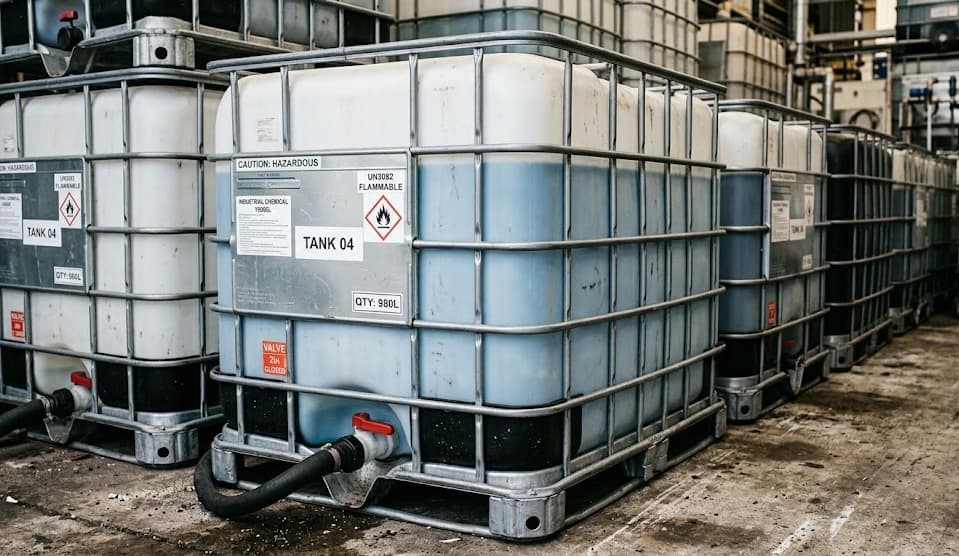
Close-up of IBC tank showing UN markings, valve, and hazmat labels

Every IBC carries detailed markings for identification and compliance

Wall Thickness & Construction

HDPE Bottle Specifications

The inner bottle of a standard HDPE IBC tank is blow-molded from high-density polyethylene resin. The wall thickness varies by manufacturer, but must meet minimum standards for UN/DOT certification.

  • Wall Thickness: 2.0 mm - 3.0 mm (average 2.5 mm)
  • Material: HDPE (High-Density Polyethylene)
  • Color: Natural (translucent white) or black (UV-resistant)
  • Blow Molding: Single-piece construction, no seams
  • FDA Compliance: Food-grade resin meets 21 CFR requirements

Steel Cage Specifications

The outer cage provides structural support and protection for the HDPE bottle. It is constructed from galvanized or powder-coated carbon steel tubing.

  • Tube Diameter: 20 mm - 25 mm outer diameter
  • Wall Thickness: 1.5 mm - 2.0 mm steel
  • Finish: Hot-dip galvanized or powder-coated
  • Grid Pattern: Welded mesh or tubular frame
  • Corner Posts: Heavy-duty vertical uprights for stacking

Performance Ratings

RatingHDPE IBCStainless Steel IBCNotes
Operating Temp Range-40°F to 140°F (-40°C to 60°C)-40°F to 400°F (-40°C to 204°C)HDPE softens above 150°F
Max Pressure (Internal)1.0 bar (14.5 psi)2.5 bar (36.3 psi)IBCs are not pressure vessels
Hydrostatic Test20 kPa (2.9 psi) for 10 min65 kPa (9.4 psi) for 10 minPer UN testing protocol
Drop Test0.8 m (2.6 ft) when full0.8 m (2.6 ft) when fullFrom bottom, diagonally, and from top
Stacking LoadUp to 6,000 lbs on topUp to 8,000 lbs on topCage must be undamaged
UV Resistance12-24 months outdoor (natural)IndefiniteBlack HDPE extends to 3-5 years
Specific Gravity RangeUp to 1.4 SGUp to 1.9 SGCheck UN markings for rated SG

Chemical Compatibility

HDPE IBC tanks are compatible with a wide range of chemicals. However, always verify compatibility with the specific chemical concentration, temperature, and duration of exposure. The following is a general guide.

Compatible (Safe)

  • Water and aqueous solutions
  • Acetic acid (up to 50%)
  • Hydrochloric acid (up to 35%)
  • Sulfuric acid (up to 70%)
  • Sodium hydroxide (up to 50%)
  • Phosphoric acid
  • Detergents and soaps
  • Glycol-based antifreeze
  • Food-grade oils
  • Alcohols (methanol, ethanol)

Limited Compatibility

  • Nitric acid (above 50%)
  • Hydrogen peroxide (above 35%)
  • Concentrated bleach (sodium hypochlorite)
  • Strong oxidizing agents
  • Certain esters and ketones
  • Some halogenated solvents

* Requires specific testing and approval

Not Compatible

  • Aromatic hydrocarbons (benzene, toluene)
  • Chlorinated solvents
  • Concentrated nitric acid
  • Fuming sulfuric acid (oleum)
  • Gasoline and diesel fuel
  • Turpentine and paint thinners

* Use stainless steel IBCs for these substances

UN Certification Markings Explained

Every certified IBC tank carries a UN marking on its data plate that encodes important information about its construction, testing, and approved uses. Here is how to read these markings.

Example UN Marking

UN 31HA1/Y/0522/USA/M-1234/SCHUTZ/1000
UNUnited Nations certified container
31H31 = Rigid IBC, H = Plastic with structural equipment (cage)
A1A1 = Composite type (plastic inner, rigid outer). A1 = rigid outer, A2 = flexible outer
YPacking group: X = I, II, III (most hazardous); Y = II, III; Z = III only (least hazardous)
0522Date of manufacture: 05 = month (May), 22 = year (2022)
USACountry of manufacture / testing authority
M-1234Manufacturer's authorization or registration number
1000Maximum capacity in liters

Date Codes & Expiration

IBC tanks carry two important dates: the manufacture date (when the inner bottle was blow-molded) and the cage manufacture date. For UN-rated IBCs used to transport hazardous materials, the bottle must be replaced or recertified every 5 years from the date of manufacture.

Date codes can appear in several formats depending on the manufacturer. Common formats include:

  • MMYY: e.g., 0522 = May 2022
  • Clock dial: Arrow pointing to month, year in center
  • Dot matrix: Stamped date on the data plate
  • Raised molding: Embossed directly into the HDPE bottle

5-Year Rule for Hazmat

Under UN regulations and DOT 49 CFR, HDPE IBC bottles used for hazardous materials must not exceed 5 years from their manufacture date. After 5 years, the bottle must be:

  • Replaced with a new bottle (rebottled)
  • Retested and recertified by an approved facility
  • Retired from hazmat service and used for non-hazmat only

For non-hazardous materials like water, food ingredients, or non-regulated chemicals, the 5-year rule does not apply, but bottle condition should still be assessed regularly.

Valve Types

Butterfly Valve

Most Common

The standard discharge valve on most HDPE IBCs. Features a disc-type closure that rotates 90 degrees to open and close. Available in 2" (50 mm) and 3" (80 mm) sizes.

  • Pros: Low cost, easy to use, self-draining
  • Cons: Can drip at low flow, disc obstructs flow
  • Best for: General-purpose, low-viscosity liquids
  • Connection: NPS or BSP threaded outlet

Ball Valve

Premium Option

A higher-quality discharge valve that uses a rotating ball with a bore hole for full-port flow. Provides a tighter seal and better flow characteristics than butterfly valves.

  • Pros: Full-bore flow, tight shutoff, durable
  • Cons: Higher cost, not always self-draining
  • Best for: Chemicals, viscous liquids, food-grade
  • Connection: NPS or BSP threaded outlet

Cam-Lock Valve

Quick Connect

A quick-connect discharge system that uses cam arms and a gasket for tool-free connection and disconnection. Popular in applications requiring frequent hose connections.

  • Pros: Quick connect/disconnect, no tools needed
  • Cons: Cam gaskets wear, more expensive
  • Best for: Transfer operations, pumping systems
  • Connection: Cam and groove (Type A-F)

Pallet Specifications

SpecificationWooden PalletPlastic PalletSteel Pallet
Dimensions40" x 48" x 6"40" x 48" x 6"40" x 48" x 5.5"
Weight40-50 lbs (18-23 kg)30-35 lbs (14-16 kg)55-65 lbs (25-30 kg)
Load Capacity3,300 lbs (1,500 kg)3,300 lbs (1,500 kg)5,500 lbs (2,500 kg)
Forklift Entry4-way4-way2-way or 4-way
Lifespan2-4 years8-12 years15-20 years
Moisture ResistantNo (requires treatment)YesYes (if galvanized)
ISPM-15 CompliantWhen heat-treated (HT)N/A (exempt)N/A (exempt)
RepairableYes (boards replaceable)NoYes (welding)
RecyclableYes (mulch/biomass)Yes (regrind)Yes (scrap metal)
Best ForGeneral use, budgetHygiene, exportHeavy loads, durability

HDPE Material Properties

Physical Properties

Density0.941 - 0.965 g/cm3
Melt Flow Index (MFI)4 - 10 g/10min
Tensile Strength25 - 45 MPa (3,600 - 6,500 psi)
Elongation at Break100 - 1,000%
Flexural Modulus900 - 1,550 MPa
Impact Strength (Izod)20 - 200 J/m
Hardness (Shore D)60 - 70
Melting Point248 - 266 F (120 - 130 C)
Vicat Softening Point255 F (124 C)
Coefficient of Friction0.29 (static)

Environmental Resistance

UV Resistance (natural)Moderate -- 12-24 months outdoor
UV Resistance (black)Good -- 3-5 years outdoor
Water Absorption (24hr)Less than 0.01%
Moisture PermeabilityVery low
Stress Cracking ResistanceGood (ESCR tested)
Oxidation ResistanceGood (with antioxidant additives)
Biological ResistanceExcellent -- does not support growth
Ozone ResistanceExcellent
Weathering (accelerated)1,000 - 3,000 hrs (Xenon arc)
FlammabilityHB rated (slow burn)

Testing Standards & Methods

Every UN-certified IBC must pass a battery of standardized tests before it is approved for use. Below is a detailed breakdown of the testing protocols required under UN Model Regulations and how they are performed.

Drop Test (UN 6.5.6.9)

Procedure:

The IBC is filled to maximum gross mass and dropped from 0.8 meters onto a rigid, non-resilient surface. Three orientations are tested: flat on bottom, on the most vulnerable corner, and diagonally. The IBC must not leak.

Pass Criteria:

No leakage from the bottle, valve, or seams. Minor cage deformation is acceptable if structural integrity is maintained.

Stacking Test (UN 6.5.6.6)

Procedure:

A force equal to 1.8 times the maximum gross mass is applied to the top of the IBC for a minimum of 24 hours (or 28 days for plastics to account for creep). Temperature is maintained at 40 degrees C for plastic IBCs.

Pass Criteria:

No leakage, no permanent deformation that would impair stacking capability, and no reduction in structural strength that would compromise safety.

Hydraulic Pressure Test (UN 6.5.6.8)

Procedure:

The IBC is filled with water and pressurized to the greater of 20 kPa (2.9 psi) or the vapor pressure of the product at 55 degrees C plus the hydrostatic head. Pressure is maintained for 10 minutes.

Pass Criteria:

No leakage, weeping, or permanent deformation. The bottle, valve, cap, and all joints must remain liquid-tight under sustained pressure.

Bottom Lift Test (UN 6.5.6.4)

Procedure:

The IBC is loaded to 1.25 times its maximum gross mass and lifted by forklift tines engaging the pallet from all four sides, held suspended for 5 minutes per lift direction.

Pass Criteria:

No permanent deformation to the pallet or cage that would compromise safe handling. The pallet must not crack, split, or separate from the cage.

Top Lift Test (UN 6.5.6.5)

Procedure:

The IBC is loaded to 2 times its maximum gross mass and lifted by the top frame (where crane or spreader bar attachments connect) for 5 minutes.

Pass Criteria:

No permanent deformation of the top frame or detachment from the vertical corner posts. This test validates overhead lifting capability.

Vibration Test (UN 6.5.6.13)

Procedure:

The IBC is placed on a vibration table and subjected to 1 hour of sinusoidal vibration at frequencies of 1-200 Hz to simulate road transport conditions. The sweep rate is 1 octave per minute.

Pass Criteria:

No leakage, no visible damage to the bottle, cage, pallet, valve, or any closures. This test ensures the IBC survives long-distance trucking.

Gasket & Seal Specifications

PropertyEPDMSiliconeViton (FKM)PTFE
Temperature Range-40 to 250 F-80 to 400 F-15 to 400 F-330 to 500 F
FDA Food GradeYesYesYes (select grades)Yes
Chemical ResistanceGood (acids, bases)ModerateExcellent (solvents)Excellent (universal)
Oil ResistancePoorFairExcellentExcellent
Hardness (Shore A)40-9010-8055-9055-65 (Shore D)
Lifespan5-10 years10-15 years10-20 years15-25 years
CostLowMediumHighHigh
Best ForWater, food, generalFood, pharmaChemicals, solventsAggressive chemicals